One-Pager
Fluids, IV Therapy and Electrolytes
IV fluids by tonicity, fluid deficit vs overload, infiltration, extravasation and phlebitis, six electrolyte pairs and safe IV potassium
Download one-page PDFLetter landscape, ready to print or keep with your notes
Watch the explainer
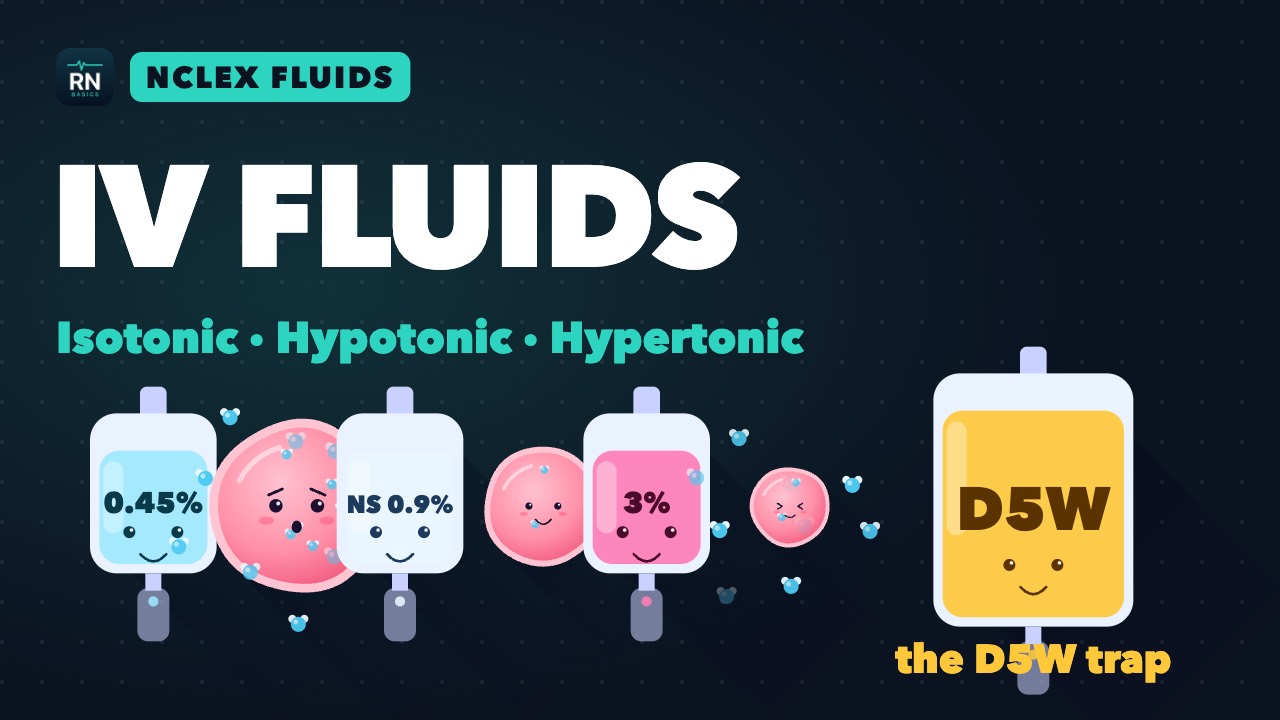
IV Fluids Explained: Isotonic, Hypotonic, Hypertonic (NCLEX)
IV fluids by tonicity
Exam study summary, not a bedside tool. Plasma is about 280–310 mOsm/L.
| Type | Examples (mOsm/L) | Used for | Main hazard |
|---|---|---|---|
| Isotonic | 0.9% NaCl (308); lactated Ringer's (273) | Volume loss: bleeding, GI losses, burns, surgery; NS with blood | Overload (heart or kidney failure). LR has K: avoid with high K or severe kidney disease |
| Isotonic in the bag, then hypotonic | D5W (252) | Free water, high sodium | Not a resuscitation fluid; can drop Na and swell the brain |
| Hypotonic (water into cells) | 0.45% NaCl (154) | Cellular dehydration, high sodium | Cerebral edema, low BP. Avoid with raised ICP, burns, trauma, liver failure |
| Hypertonic (water out of cells) | 3% NaCl (1027); D10W (505) | 3%: severe symptomatic low Na (ICU) | Overload, high Na, vein damage (large or central vein); high glucose |
Fluid volume deficit vs excess
| Check | Deficit (hypovolemia) | Excess (hypervolemia) |
|---|---|---|
| Vitals, pulse | Low BP, fast HR, weak pulse, orthostatic drop | High BP, fast breathing, low SpO₂, bounding pulse |
| Neck, lungs | Possible shortness of breath | JVD, crackles (bases first), S3, dyspnea |
| Skin, mouth | Tenting, dry sticky mouth, slow refill | Pitting edema, tight shiny skin |
| Urine | Low, concentrated, high specific gravity | Can also be low (failing heart or kidneys) |
| Weight (1 kg ≈ 1 L) | Loss over 1 kg in 24 h | Gain over 1 kg in 24 h |
| Labs | Hct, BUN, osmolality high | Hct, BUN, osmolality low |
- Deficit: fluids within reach, isotonic IV as ordered, I&O, orthostatic vitals (SBP drop over 20, DBP over 10 or dizziness: fall precautions).
- Excess: HOB up, diuretics, fluid and sodium limits, ice chips, elevate edematous limbs, turn often.
- Both: daily weight, same scale, time and clothing. Report urine under 30 mL/h (0.5 mL/kg/h).
IV site complications
| Problem | What you see | Nurse action |
|---|---|---|
| Infiltration (non-vesicant fluid in tissue) | Swelling, cool pale skin, tightness, leaking, slowed flow | Stop, remove, elevate, compress per policy, restart at a new site |
| Extravasation (vesicant in tissue) | Pain, swelling, redness or blanching, lost blood return; later blisters, necrosis | Stop, disconnect, aspirate (no flush), remove, mark borders, elevate, notify, antidote per protocol |
| Phlebitis | Redness, warmth, tenderness along the vein, palpable cord | Remove, restart at a new site, warm compress, notify |
| Site infection | Redness, warmth, tenderness, fever | Remove, notify; antibiotics as ordered |
Electrolytes: signs and nursing priorities
| Imbalance | Signs | ECG | Priority actions |
|---|---|---|---|
| Low Na | Headache, nausea, confusion, seizures | — | Seizure precautions; fluid limit (SIADH, overload) or NS (deficit); rise ≤8 mEq/L in 24 h |
| High Na | Thirst, sticky mouth, confusion, seizures | — | Free water (oral, D5W, 0.45%), slowly; neuro checks |
| Low K | Weakness, cramps, ileus, dysrhythmias | ST sag, flat T, U wave | Replace K, check Mg; monitor; digoxin risk |
| High K | Weakness, cramps, diarrhea, paralysis | Peaked T, long PR, wide QRS, lost P, sine wave | Monitor; stop K sources; IV calcium, insulin-dextrose, binders, dialysis |
| Low Ca | Tingling, Chvostek, Trousseau, tetany, laryngospasm, seizures | Long QT | Airway, seizure precautions; IV calcium slowly on a monitor; fix Mg |
| High Ca | Constipation, polyuria, stones, weakness, confusion | Short QT | IV saline, then loop diuretic; mobilize; digoxin caution |
| Low Mg | Tremor, brisk reflexes, tetany, seizures | Long QT, torsades | Replace Mg; seizure precautions; replace K and Ca too |
| High Mg | Lost reflexes, low BP, slow breathing, lethargy | Long PR, wide QRS | Stop Mg; reflexes, RR, urine; IV calcium; support breathing |
| Low phos | Weakness, breathing failure, confusion (refeeding, alcohol, DKA recovery) | — | Replace, IV only if severe, slowly; watch Ca |
| High phos | Often none; low-Ca signs | Low-Ca changes | Binders with meals, low-phosphate diet, dialysis |
Safe IV potassium
- Check urine output and kidney function first.
- Premixed bags; concentrate is kept off patient-care units.
- Always diluted, always on a pump; if added to a bag, mix fully.
- Peripheral: usually 10 mEq/h or less. Burning: slow per protocol, check for infiltration.
- Faster: central line and continuous ECG per policy; label allows 40 mEq/h only if K is under 2 with ECG changes or paralysis.
- Recheck K; watch the ECG and the site.
In depth
The one-page summary above is what the PDF prints. These sections go further.
Tonicity: why fluids move
Water crosses cell membranes toward the side with more dissolved particles. The labels give normal plasma osmolarity as about 280–310 mOsm/L. A fluid in that range (0.9% saline 308, lactated Ringer's 273) causes no shift into or out of cells and stays in the vessels, which is why it is the volume fluid. A fluid below it (0.45% saline 154) lets water into cells, which helps cellular dehydration but can swell brain cells. A fluid above it (3% saline 1,027) draws water out of cells into the vessels.
Dextrose changes the picture. D5W measures 252 mOsm/L in the bag, but the body uses the glucose quickly and what remains is free water. The dextrose-saline label says glucose-containing fluids can become 'physiologically hypotonic' for this reason, and the dextrose labels warn that they can cause hyponatremia and hyponatremic encephalopathy; the fluid labels name children, older adults, postoperative clients and those on diuretics as most at risk. D5/0.45% saline (406), D5LR (525) and D5/0.9% saline (560) are labeled hypertonic for the same reason: the dextrose adds particles that disappear once it is used, leaving 0.45% saline (hypotonic) or LR or 0.9% saline (isotonic).
Vein tolerance follows osmolarity. The dextrose labels allow a peripheral vein for 5% dextrose or less and osmolarity under 900 mOsm/L and suggest a central vein at 900 or above. The 3% saline label asks for a large vein for rapid dilution, and the label on the most concentrated premixed KCl bags reads 'hypertonic, may cause vein damage'.
Fluid choice: label cautions worth knowing
- 0.9% saline: overload and pulmonary edema in clients at risk; hyperchloremic metabolic acidosis is a listed adverse reaction; it can still lower Na in clients with high ADH (SIADH, after surgery) given large volumes.
- Lactated Ringer's (Na 130, K 4, Ca 2.7, lactate 28 mEq/L): avoid with high K, severe kidney disease, or drugs that raise K (potassium-sparing diuretics, ACE inhibitors, ARBs); never with ceftriaxone in a neonate 28 days or younger; for older clients, give ceftriaxone and LR one after the other with a thorough flush.
- D5W and other dextrose fluids: hyperglycemia in diabetes; hyponatremia; a client with high glucose should not receive them.
- 0.45% saline: monitor Na and neuro status; avoid when ICP is raised.
- 3% saline: monitor Na closely; overload in heart, liver and kidney disease; too-fast correction risks osmotic demyelination; do not run it through the same set as blood.
Worked example: a client with a GI bleed has BP 86/50 and HR 126. The fluid to expect is 0.9% saline or lactated Ringer's through large-bore access while blood is prepared. D5W and 0.45% saline leave the vessels and do little for pressure.
Worked example: a client after a head injury is ordered 0.45% saline at maintenance. The nurse questions the order: hypotonic fluid moves water into brain cells and can raise ICP.
Assessing volume at the bedside
Trends matter more than single numbers. Open RN treats a 1 kg change in 24 hours as significant because it is about 1 L of fluid; weigh on the same scale, at the same time, in similar clothing. Check orthostatic vitals in a client with suspected deficit: a systolic drop over 20 mm Hg, a diastolic drop over 10, or dizziness is abnormal and calls for fall precautions.
In overload, crackles usually appear first in the lower posterior lungs; pink frothy sputum signals pulmonary edema. Assess JVD with the head of the bed at 30–45 degrees. Lab values dilute in excess (Hct, BUN and osmolality fall) and concentrate in deficit (they rise). Urine specific gravity rises in deficit (normal about 1.010–1.020).
- Unstable client with a deficit: vitals every 15 minutes to 1 hour; I&O every 4 hours.
- Watch for shock: falling BP, rising HR, cool skin, confusion, little urine.
- Older adults feel less thirst: keep fluids in reach and offer them.
- Children on IV fluids: check the site hourly and the volume infused often.
Infiltration and extravasation step by step
The Infusion Nurses Society separates the two by what leaked: infiltration is a non-vesicant fluid or drug in the tissue, extravasation is a vesicant. Both start the same way: stop the infusion at the first sign. Compare the limb with the other side, check above and below the site, and check sensation, movement and pulses.
- Stop the infusion and disconnect the tubing.
- Vesicant: slowly aspirate what remains through the catheter or port needle; do not flush.
- Leave the catheter in place until the drug is aspirated and, if the protocol uses it, part of the antidote is given through it; then remove it without pressing hard on the site.
- Measure the area and outline the swelling or redness with a marker.
- Elevate a peripheral limb (sources give up to 48 hours).
- Notify the provider and give any antidote as ordered: into the surrounding tissue with a fine needle (or the other arm, e.g. dexrazoxane), and for phentolamine some protocols give part through the cannula before it comes out.
- Compress per the agent: warm for vasopressors (never cold), vinca alkaloids, etoposide and oxaliplatin; cold for anthracyclines, most alkylating agents and antimetabolites (ASCO/ONS: 15–20 minutes, 3–4 times a day for 48–72 hours). For other fluids, per policy and comfort; sources differ on hypertonic fluids (cold in Hadaway, warm in Smolders).
- Document the agent, site, device, estimated volume, size, actions and the client's response; teach the client what to report.
| Leaked drug | Antidote (per protocol) |
|---|---|
| Norepinephrine and other vasoconstrictors | Phentolamine infiltrated into the area with a fine needle as soon as possible (label: 5–10 mg in 10–15 mL saline in adults; works if given within 12 h), with warm compresses; watch for the blanched area to turn pink, and repeat per protocol if it stays pale. Restart the vasopressor at another site promptly: stopping it abruptly can drop the BP |
| Anthracyclines (doxorubicin) | Dexrazoxane IV in the other arm, first dose within 6 h |
| Vinca alkaloids; some fluids and drugs | Hyaluronidase injected under the skin around the site as soon as possible (ASCO/ONS for vinca: within 2–4 h; Smolders for other drugs: within 60 min) |
Phlebitis, infection and site care
Phlebitis is inflammation of the vein, often from insertion trauma or an irritating infusate. Open RN describes redness and tenderness along the vein; a firm, palpable cord is a later sign. The dextrose label says to remove the catheter as soon as possible if thrombophlebitis develops. Warm compresses and an NSAID may be ordered. An untreated phlebitic vein can become infected.
- Assess the site every time you see the client and throughout therapy; check the tubing, rate and solution too (Open RN).
- A site that will not flush is not patent: remove and restart.
- Flush an idle saline lock per agency policy to check patency.
- Scrub needleless connectors, limit access and use aseptic technique.
- CDC 2011: chlorhexidine over 0.5% in alcohol, allowed to dry; replace a dressing that is damp, loose or soiled (transparent central-line dressings at least every 7 days).
Electrolyte replacement: label safety points
- KCl concentrate: diluted before use; at K over 2.5, no faster than 10 mEq/h, up to 40 mEq/L, 200 mEq in 24 h. Mix fully if added to a soft bag. Contraindicated with high K or kidney failure.
- Premixed KCl: calibrated pump; peripheral infusion can hurt, so the label prefers a central route; 300 and 400 mEq/L bags are central only.
- Severe low K: the KCl label prefers saline to dextrose fluids and Merck avoids dextrose diluents, because dextrose raises insulin and pushes K into cells.
- Magnesium sulfate: safe dosing shows a patellar reflex and RR of about 16 or more; keep urine at least 100 mL every 4 hours. Reflexes weaken above about 4 mEq/L and may vanish near 10, with risk of respiratory paralysis. Support breathing and give IV calcium for toxicity.
- IV phosphate: slowly over hours (Merck: about 0.5 mmol/kg over 6 hours); too fast drops Ca. Potassium phosphate also delivers potassium, so check K and kidney function.
- Calcium: never with ceftriaxone in neonates; in older clients, flush between them and never run them together at a Y-site. Give slowly with ECG monitoring on digoxin.
Common traps
- D5W is not a volume expander.
- Lactated Ringer's contains potassium; it is a poor choice in kidney failure with high K.
- Burning with peripheral KCl calls for slowing per protocol and a site check, never an IV push to finish it.
- Hypercalcemia from bed rest improves when the client moves.
- Chvostek and Trousseau signs point to low Ca, but low Mg causes them too.
- A falling urine output in a client on magnesium is a toxicity risk, not just a kidney issue.
Exam pearls
- Hemorrhage or shock: 0.9% saline or LR first.
- Raised ICP: avoid hypotonic fluids.
- 1 kg in 24 hours ≈ 1 L of fluid.
- Infiltration: stop, remove, elevate, restart elsewhere. Extravasation: stop, aspirate, then remove, mark, notify, antidote.
- Peaked T: high K. U wave: low K. Long QT: low Ca or low Mg. Short QT: high Ca.
- Lost reflexes on magnesium: stop the Mg; calcium is the antidote.
- After thyroid surgery: watch for tingling, tetany and stridor (low Ca).
Related one-pagers
- Infection Control and IsolationStandard and transmission-based precautions, PPE order, hand hygiene, neutropenic precautions, sharps and room assignment
- Isolation Precautions by OrganismStandard, contact, droplet and airborne precautions by organism, PPE order, N95 fit, AIIR, cohorting, transport, neutropenic precautions and visitor teaching
- Client PositioningPositions by situation: after surgery and procedures, breathing, shock, ICP, feeding, pregnancy, newborns, pressure injury, log rolling and traction
- Therapeutic DietsLiquid and IDDSI texture diets, sodium, renal and carbohydrate diets, special diets, drug–food interactions, nutrient-rich foods and NPO
- Diagnostic Tests and Procedure PrepBefore, during and after cath, thoracentesis, paracentesis, LP, biopsies, bronchoscopy, contrast CT and MRI, scopes and bowel prep, EEG, stress tests and PFTs
- Perioperative CareConsent, NPO times, home medications, checklist and time-out; PACU priorities and Aldrete; post-op complications by timing, dehiscence, malignant hyperthermia
Calculators for this topic
Sources
- Ernstmeyer K, Christman E, eds. Nursing Fundamentals (Open RN). Chapter 15: Fluids and Electrolytes (15.2 Basic Concepts, 15.3 Intravenous Solutions, 15.4 Electrolytes, 15.6 Applying the Nursing Process). LibreTexts. Link
- Ernstmeyer K, Christman E, eds. Nursing Skills (Open RN). Chapter 23: IV Therapy Management (23.2 IV Therapy Basics, 23.3 Intravenous Therapy Assessment). LibreTexts. Link
- Centers for Disease Control and Prevention. Guidelines for the Prevention of Intravascular Catheter-Related Infections (2011; dressing regimens updated 2017): Summary of Recommendations. Link
- Merck Manual Professional Version: Intravenous Fluid Resuscitation (full review June 2026). Link
- Nickel B, Gorski L, Kleidon T, et al. Infusion Therapy Standards of Practice, 9th Edition. J Infus Nurs. 2024;47(1S). Cited through Hadaway; not opened directly. Link
- Hadaway L. Protect patients from I.V. infiltration. American Nurse Journal. July 11, 2009 (INS definitions of infiltration and extravasation). Link
- Oncology Nursing Society and American Society of Clinical Oncology. Algorithm on the Management of Antineoplastic Extravasation of Vesicant or Irritant with Vesicant Properties in Adults (guideline supplement B). 2026. Link
- Smolders EJ, Benoist GE, Smit CCH, ter Horst P. An update on extravasation: basic knowledge for clinical pharmacists. Eur J Hosp Pharm. 2021;28(3):165–167. Link
- Baxter Healthcare. Lactated Ringer's Injection, USP. Prescribing information. DailyMed. Link
- Baxter Healthcare. Sodium Chloride Injection, USP (0.45% and 0.9%) in VIAFLEX container. Prescribing information. DailyMed. Link
- Baxter Healthcare. 3% and 5% Sodium Chloride Injection, USP. Prescribing information. DailyMed. Link
- Baxter Healthcare. Dextrose and Sodium Chloride Injection, USP. Prescribing information. DailyMed. Link
- Baxter Healthcare. Lactated Ringer's and 5% Dextrose Injection, USP. Prescribing information. DailyMed. Link
- Baxter Healthcare. Dextrose Injection, USP (5% and 10%). Prescribing information. DailyMed. Link
- Hospira. Potassium Chloride for Injection Concentrate, USP. Prescribing information, revised 01/2026. DailyMed. Link
- ICU Medical. Potassium Chloride Injection (premixed). Prescribing information, revised June 2018. DailyMed. Link
- Hospira. Magnesium Sulfate in Water for Injection. Prescribing information, revised 06/2026. DailyMed. Link
- Baxter Healthcare. Norepinephrine Bitartrate Injection. Prescribing information, revised January 2022. DailyMed. Link
- WG Critical Care. Calcium Gluconate Injection. Prescribing information. DailyMed. Link
- International Medication Safety Network. Global Targeted Medication Safety Best Practice 1: concentrated potassium. June 2019. Link
- Merck Manual Professional Version: Hyponatremia; Hypokalemia; Hyperkalemia (Electrolyte Disorders; full review June 2025). Link
- Merck Manual Professional Version: Hypocalcemia; Hypercalcemia (full review June 2025). Link
- Merck Manual Professional Version: Hypomagnesemia; Hypermagnesemia (full review June 2025). Link
- Merck Manual Professional Version: Long QT Syndrome and Torsades de Pointes Ventricular Tachycardia (full review Sept 2024). Link
- Merck Manual Professional Version: Hypophosphatemia (full review June 2025). Link