 RN Basics
Video explainer · Cardiac
Heart Failure Explained: Left vs Right, HFrEF vs HFpEF, BNP, Diuretics, Digoxin | NCLEX CCRN NREMT
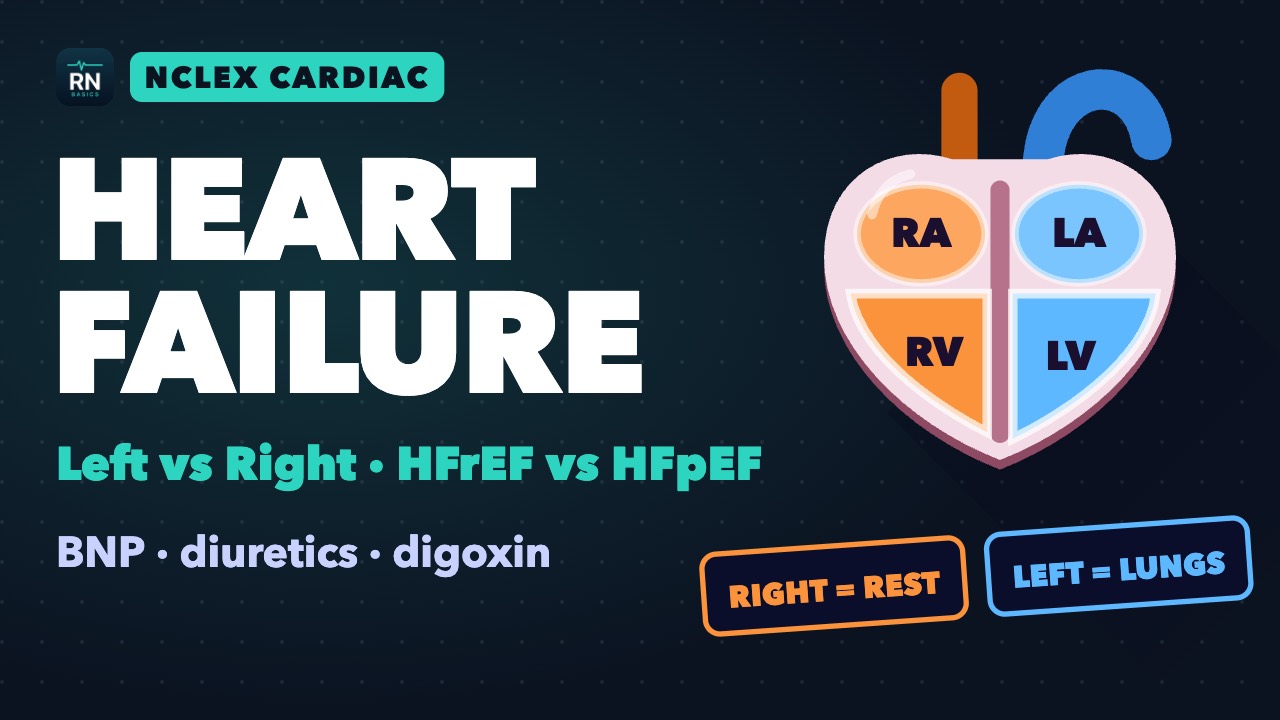
Heart failure from the pump up: preload, afterload and contractility, and the left-sided and right-sided signs.
This video covers HFrEF versus HFpEF with the 2022 ejection fraction cutoffs and the 2026 changes, BNP and NT-proBNP, daily weights, the four HFrEF drug pillars, which electrolytes each diuretic moves, digoxin toxicity and the antidote, and decompensated heart failure from the ambulance to the ICU, for NCLEX, CCRN and NREMT review.
Chapters
- 0:00 Heart failure: the pump can’t keep up
- 0:21 What heart failure is: preload, afterload, contractility
- 1:07 Left vs right heart failure
- 2:06 HFrEF vs HFpEF: ejection fraction groups
- 2:55 BNP and NT-proBNP
- 3:38 Daily weights
- 4:07 Treatment pillars for HFrEF
- 4:58 Diuretics and electrolytes
- 6:02 Digoxin: toxicity and the antidote
- 7:24 Acute decompensation: hospital and EMS
- 9:02 Recap
Study the topic
In the Reference
Transcript
Heart failure: the pump can’t keep up
0:00 Heart failure doesn’t mean the heart has stopped. It means the pump can’t keep up with the body’s needs. When it falls behind, fluid backs up: into the lungs, the legs, and onto the scale. This is exam education, not advice for any one patient. Orders and protocols decide.
What heart failure is: preload, afterload, contractility
0:23 Formally, it is a clinical syndrome. Cardiac output is stroke volume times heart rate; stroke volume depends on three things. Preload: how full the ventricle is at the end of filling. Think stretch.
0:39 Afterload: the force the ventricle has to push against to eject. Think resistance. Contractility: how hard the muscle itself squeezes. When output falls, the renin angiotensin aldosterone system holds salt and water, and sympathetic tone rises. Short term, that helps. Long term, it worsens heart failure, so most heart failure drugs block these systems.
Left vs right heart failure
1:09 Left or right? Ask where the blood backs up. When the left ventricle fails, blood backs up into the lungs. Left is lungs.
1:20 Dyspnea. Crackles that don’t clear with a cough. Orthopnea: breathless lying flat, better sitting up. And waking up breathless hours later: paroxysmal nocturnal dyspnea.
1:34 At its worst, pulmonary edema: extreme breathlessness and frothy, blood-tinged sputum, the classic pink froth. When the right ventricle fails, blood backs up into the body. Right is the rest. Jugular venous distention. Swollen ankles and feet.
1:54 An enlarged liver, with right upper belly discomfort. Ascites. And weight gain from retained fluid. The most common cause of right heart failure is left heart failure.
HFrEF vs HFpEF: ejection fraction groups
2:09 Ejection fraction, or EF, is the share of ventricular blood pumped out with each beat. The 2021 universal definition and 2022 US guideline use these groups. Heart failure with reduced EF: 40% or less. Mildly reduced: 41 to 49.
2:31 Preserved EF: 50 or more. The squeeze looks normal, but the stiff ventricle fills poorly. In 2026, the second universal definition dropped fixed cutoffs, and the European guideline folded mildly reduced into reduced: below 50. For US exams, for now, expect 40 and 50.
BNP and NT-proBNP
2:57 BNP, B-type natriuretic peptide, comes mainly from the ventricles, released more when they stretch. NT-proBNP is the inactive fragment from the same precursor. Both are measured in blood. Commonly cited cutoffs supporting heart failure, outpatient: BNP 35 or more, or NT-proBNP 125 or more.
3:24 In the hospital or when decompensated: 100, or 300. The traps: obesity lowers it, kidney disease raises it, and a normal level does not rule heart failure out.
Daily weights
3:40 The cheapest monitor is a scale. Weigh every morning, on the same scale, after voiding, before breakfast, in similar clothing. A liter of fluid weighs about a kilogram: 2.2 pounds. The commonly taught rule: call for a gain of more than 2 to 3 pounds in a day, or 5 in a week. Thresholds vary, so teach the number in the patient’s own plan.
Treatment pillars for HFrEF
4:09 Reduced EF treatment rests on four foundational drug classes: the four pillars. One: an ARNI, sacubitril-valsartan, or an ACE inhibitor or ARB. Two: an evidence-based beta blocker, to blunt the sympathetic drive. Three: a mineralocorticoid receptor antagonist, or MRA, such as spironolactone.
4:35 Four: an SGLT2 inhibitor, such as dapagliflozin or empagliflozin. Together they lower deaths and heart failure hospital stays. Diuretics relieve congestion and symptoms, but they are not a pillar. And SGLT2 inhibitors help across the whole EF range, preserved included.
Diuretics and electrolytes
5:00 Diuretics move fluid, and electrolytes go with it. Loop diuretics, like furosemide, act in the loop of Henle; the label warns of profound water and electrolyte loss. Potassium falls. Magnesium falls. Sodium and calcium can fall too.
5:19 Thiazides, like hydrochlorothiazide, work at the distal tubule. Potassium and magnesium fall here too, but calcium can rise. Low potassium and low magnesium can provoke ventricular arrhythmias, and they make digoxin more toxic. Spironolactone is the opposite: it blocks aldosterone and holds potassium, so potassium rises.
5:44 Risk climbs with kidney impairment, potassium supplements, salt substitutes, and ACE inhibitors or ARBs. Check potassium within a week of starting or a dose change. For all of them, monitor electrolytes, kidney function, weight and blood pressure.
Digoxin: toxicity and the antidote
6:04 Digoxin blocks the sodium potassium pump in heart cells, strengthening contraction, and it slows conduction through the AV node. So it’s a positive inotrope for heart failure and rate control for atrial fibrillation. The kidneys clear it, so worse kidney function raises the level. Toxicity often starts in the gut: loss of appetite, nausea, vomiting.
6:30 Then the eyes: blurred vision, green-yellow color changes, and halos around lights. And confusion. And almost any arrhythmia: heart block, junctional rhythms, ventricular arrhythmias. Low potassium, low magnesium and high calcium all raise the risk.
6:50 So a loop diuretic plus digoxin means watching the potassium. As commonly taught: count the apical pulse for a full minute. In an adult, hold the dose for under 60 and notify the prescriber, or follow the order’s hold parameters. The antidote for life-threatening toxicity is digoxin immune fab.
7:12 It binds the drug. After the fab, potassium can drop fast: recheck it. Draw any digoxin level before the fab; afterward it misleads.
Acute decompensation: hospital and EMS
7:26 Acute decompensation. The European guideline now calls it decompensated heart failure, because it can build over days. The picture: extreme breathlessness, crackles, low saturation, anxiety, sweating, sometimes a very high blood pressure. First, sit the patient upright.
7:48 Oxygen as needed. The EMS model guideline targets 94 to 98%. CPAP or bilevel for respiratory distress. It about halves intubations.
8:01 Nitroglycerin dilates veins to lower preload; higher doses lower afterload too. Then, in the hospital, an IV loop diuretic. Paramedics: the model guideline puts oxygenation first, CPAP or bilevel, before or with the drugs. Then sublingual nitroglycerin: 0.4 milligrams if the systolic is under 160, 0.8 at 160 or more, every 5 minutes while it stays above 100.
8:32 No nitrates within 48 hours of sildenafil, vardenafil or tadalafil. Below 100 systolic: no nitro, a small fluid bolus, and consider norepinephrine. Furosemide in the field? The guideline says no immediate benefit for most, and harm if it is really pneumonia or sepsis.
8:53 NREMT-style: crackles, distress and an adequate blood pressure mean CPAP and nitro, per your local protocol.
Recap
9:05 Recap. Left is lungs, right is the rest. EF 40 or less is reduced, 50 or more preserved. BNP rises with stretch. Weigh every morning; call for more than 2 to 3 pounds in a day, or 5 in a week.
9:23 Four pillars for reduced EF; diuretics for congestion. Loops and thiazides drop potassium and magnesium; spironolactone raises it. Digoxin: nausea, halos, arrhythmias, worse with low potassium; fab is the antidote. Pulmonary edema: sit up, oxygen, CPAP, nitro, diuretic.
9:47 ICU Basics, RN Basics and Medic Basics. Available on the Apple App Store and Google Play.
Sources
- DailyMed, Lanoxin (digoxin) tablets Link
- DailyMed, DigiFab (digoxin immune fab) Link
- DailyMed, Furosemide tablets Link
- DailyMed, Hydrochlorothiazide capsules Link
- DailyMed, Aldactone (spironolactone) Link
- MedlinePlus, Heart failure: fluids and diuretics Link
- MedlinePlus, Digoxin Link
- Merck Manual Professional, Overview of Heart Failure Link
- Merck Manual Professional, Acute Heart Failure Link
- Merck Manual Professional, Chronic Heart Failure Link
- Merck Manual Professional, Right Heart Failure and Cor Pulmonale Link
- Merck Manual Professional, Pulmonary Edema Link
- ESC Congress news, 2026 ESC Guidelines for the management of heart failure Link
- Second Universal Definition of Heart Failure (2026), Global Heart Link
- The second universal definition of heart failure (2026): what’s new? ESC Heart Fail 2026 Link
- Ibănescu R et al. History of Heart Failure Definition. Card Fail Rev 2025 Link
- Brain natriuretic peptide biomarkers in heart failure. J Clin Med 2022 Link
- The four pillars of HFrEF therapy. Eur Heart J Suppl 2022 Link
- Witte KK et al. Four pillars of heart failure. Open Heart 2021 Link
- Clinical review of hypertensive acute heart failure. Medicina (Kaunas) 2024 Link
- Considerations for initial therapy in the treatment of acute heart failure. Crit Care 2015 Link
- Berbenetz N et al. CPAP or bilevel NPPV for cardiogenic pulmonary oedema. Cochrane 2019 Link
- NASEMSO National Model EMS Clinical Guidelines, version 3.0 (March 2022): Respiratory Distress (Pulmonary Edema) Link
For education and exam preparation only. Not medical advice; follow current guidelines and your institution’s protocols. AI narration; script written and clinically reviewed by Alex G.