 RN Basics
Video explainer · Endocrine
Insulin and DKA Explained: Types, Lows, DKA vs HHS (NCLEX)
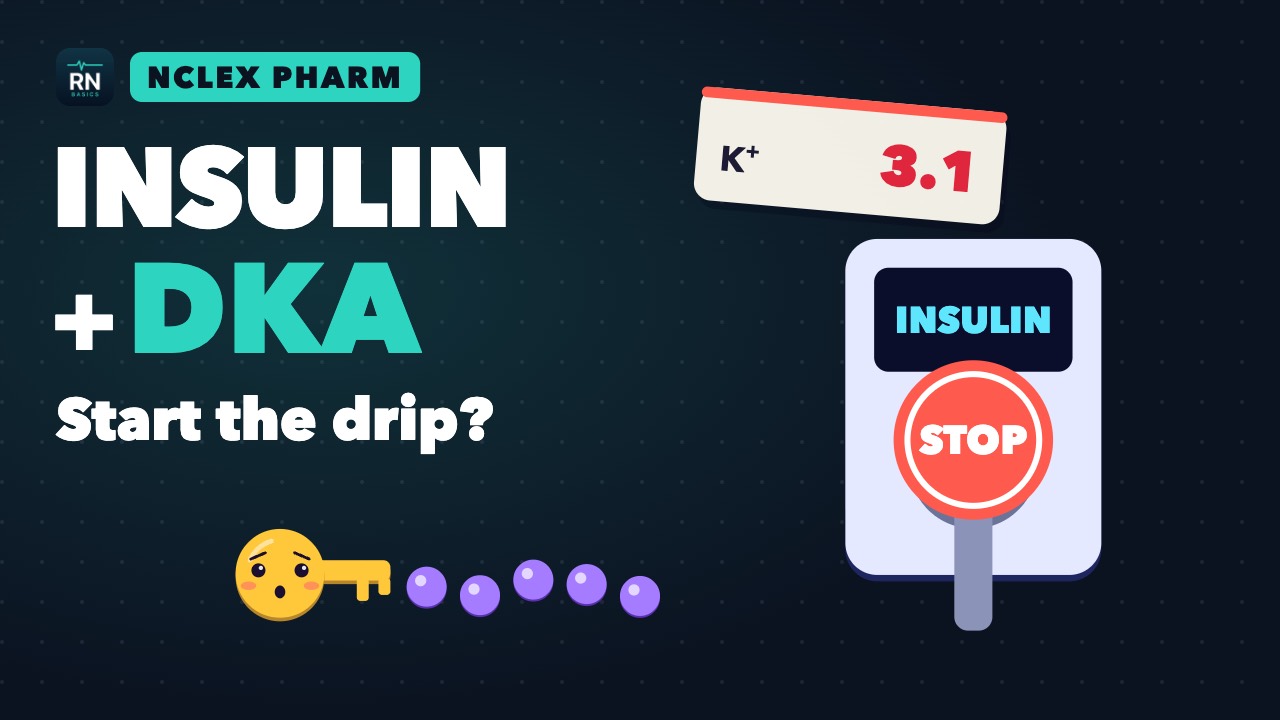
A patient in DKA has a glucose of 480, a pH of 7.18 and a potassium of 3.1. The insulin drip is ready. Do you start it? This video explains, then tests.
Learn rapid, short, intermediate and long-acting insulin; why hypoglycemia follows the peak; how to treat a low with the rule of 15; how DKA and HHS differ; why the order is fluids, potassium, insulin; when to add dextrose and why the insulin keeps running; what to monitor; and, for ICU learners, euglycemic DKA. Medics get field glucose checks, fluids per protocol and the three I’s. Then pause and answer three questions yourself.
Chapters
- 0:00 Insulin and DKA: should you start the drip?
- 0:16 How insulin works: glucose and potassium
- 0:39 Insulin types chart: onset, peak, duration
- 1:52 When lows happen: peak times
- 2:17 Hypoglycemia and the rule of 15
- 3:12 DKA vs HHS
- 4:34 DKA priorities: fluids, potassium, insulin
- 6:10 ICU depth: euglycemic DKA
- 6:33 For medics: field glucose and fluids
- 7:12 Practice: 3 NCLEX-style questions
- 8:58 Recap
Study the topic
- DKA and HHS2024 consensus criteria, treatment order, potassium, euglycemic DKA and monitoring
- Insulin Types Chart: Onset, Peak and DurationRapid, short, intermediate, long, ultra-long and premixed insulins with brand names, meal timing, mixing, hypoglycemia and NCLEX traps
In the Reference
Transcript
Insulin and DKA: should you start the drip?
0:00 Glucose, 480. pH, 7.18. Potassium, 3.1. A patient in DKA. The insulin drip is ready. Do you start it? You'll know the answer in a few minutes. Then we'll test you.
How insulin works: glucose and potassium
0:18 Think of insulin as a key. It opens the cell door so glucose can get in. Without enough keys, sugar piles up in the blood while the cells go hungry. Insulin moves potassium too. It pushes potassium into the cells. Remember that. It's the key to our patient.
Insulin types chart: onset, peak, duration
0:41 Four main groups, and 3 numbers each: when it starts, when it peaks, and how long it lasts. These times are approximate, and sources differ, so follow your facility's references. Rapid acting: lispro, aspart, and glulisine. Onset about 15 minutes, peak 1 to 2 hours, duration 3 to 5 hours.
1:06 It goes with food. If the patient is NPO, or the tray is late, clarify first. Short acting: regular insulin. Onset 30 to 60 minutes, peak 2 to 4 hours, duration 6 to 8 hours.
1:22 Regular is the classic IV insulin, the one in an insulin drip. Intermediate acting: NPH. Onset 1 to 2 hours, peak 4 to 12 hours, duration 12 to 18 hours. It's cloudy, and it never goes IV.
1:40 Long acting: glargine. Onset about 1.5 to 4 hours, no pronounced peak, duration about 24 hours. Never mix it, and never give it IV.
When lows happen: peak times
1:55 Why memorize this? A low is the most common side effect of insulin, and the risk is highest near the peak. Rapid insulin at breakfast: watch the next couple of hours. NPH in the morning: watch the afternoon. No peak doesn't mean no risk. Long acting insulin can still cause a low.
Hypoglycemia and the rule of 15
2:20 A low looks like this: shaky, sweaty, hungry, a pounding heart. As the brain runs short: headache, blurred vision, confusion, seizures, coma. Under 70 milligrams per deciliter is low. Under 54 is more serious.
2:41 Alert, and able to swallow? Use the rule of 15. Give 15 grams of fast carbohydrate: 4 oz of juice or regular soda, or glucose tablets. Recheck in 15 minutes. Still under 70?
2:56 Repeat. Back above 70, give a meal, or a carb and protein snack if no meal is coming soon. Not alert, or can't swallow? Nothing by mouth. Give glucagon or IV dextrose per protocol,
DKA vs HHS
3:11 and get help. Now the opposite problem: two hyperglycemic emergencies. DKA: too little insulin. With the doors shut, the body burns fat, and that makes ketones, which are acids.
3:29 It develops over hours to a few days, and it's more common in younger people with type 1 diabetes. Look for deep, rapid Kussmaul breathing, fruity breath, vomiting, and belly pain. The numbers: glucose 200 or higher, or known diabetes. Ketones up. pH under 7.3, or bicarb under 18.
3:54 HHS: a little insulin is left. That limits the ketones, but the sugar keeps climbing. It builds over days to weeks, and it's more common in older adults with type 2 diabetes. Sugar drags water out through the urine, so dehydration is extreme, and confusion is common.
4:15 The numbers: glucose 600 or higher, effective osmolality over 300, no big ketones, pH at least 7.3, and bicarb at least 15. DKA is the acid problem. HHS is the dehydration problem.
DKA priorities: fluids, potassium, insulin
4:36 The DKA order: fluids, potassium, insulin. Fluids first: an isotonic crystalloid per protocol. Potassium next, and here's trap number 1. Most patients arrive with a normal or high potassium, but total body potassium is low.
4:55 Insulin drives potassium into cells. About half of patients drop below 3.5 during treatment. So if potassium is below 3.5, hold the insulin and replace potassium first. Some references still use 3.3.
5:12 Otherwise you risk deadly arrhythmias and weak breathing muscles. Once potassium is safe, start regular IV insulin per protocol, and keep replacing potassium as ordered. Trap number 2: glucose falls long before the acid clears. When glucose drops below 250, add dextrose to the fluids, and keep the insulin running.
5:36 Check glucose every 1 to 2 hours, or per protocol, and electrolytes, venous pH, and ketones about every 4. Many protocols and exams watch the anion gap close. The 2024 consensus drops the gap, and goes by ketones, plus pH or bicarb, shown here. Treat the cause too. Infection and missed insulin are the most common triggers. HHS is similar: fluids first, potassium checked, then low dose insulin, and a slow correction.
ICU depth: euglycemic DKA
6:13 Now an optional ICU depth note. Euglycemic DKA: ketones and acidosis with glucose under 200. It's about 10% of DKA. Think of it in a sick patient on a -gliflozin, an SGLT2 inhibitor. Stop that drug on admission.
For medics: field glucose and fluids
6:35 For medics: check a glucose on any patient with altered mental status, a seizure, or stroke signs. The national model EMS guideline treats at 60 or below: oral glucose if the airway is safe, otherwise dextrose or glucagon. Follow your protocol. For glucose over 250 with dehydration, vomiting, or altered mental status, give fluids per protocol, without overdoing it.
7:03 Get a 12-lead for hyperkalemia changes, and think insulin, ischemia, infection. Insulin itself waits for the hospital.
Practice: 3 NCLEX-style questions
7:14 Question 1. A patient gets NPH at 0700. When is a low most likely? A: 0730.
7:23 B: 0830. C: 1500. D: 0300 the next day. Pause, and try it.
7:36 C: 1500. NPH peaks 4 to 12 hours after the dose, and 1500 is 8 hours in. Question 2. Glucose 62. The patient is shaky but alert, and lunch is 45 minutes away. What first?
7:54 A: call the provider. B: give glucagon. C: give 4 oz of juice, and recheck in 15 minutes. D: give the scheduled lispro.
8:06 Pause, and try it. C. Alert and swallowing means oral carbs first. Glucagon is for a patient who can't swallow, and lispro would push the glucose lower.
8:21 Question 3. Our patient: glucose 480, pH 7.18, potassium 3.1. The orders: A, saline bolus. B, IV potassium. C, start the insulin drip. D, hourly glucose checks.
8:41 Which do you question? Pause, and try it. C. Potassium 3.1 is low by any reference. Fluids and potassium go first. Insulin now could drive it dangerously lower.
Recap
9:01 Recap: know the peak. Treat lows with 15 and 15. In DKA: fluids, potassium, insulin. Add dextrose at 250, and keep the insulin going until the ketones and acid clear.
9:16 Practice free with RN Basics, ICU Basics, and Medic Basics.
Sources
- Hyperglycaemic crises in adults with diabetes: a consensus report (Umpierrez et al., Diabetologia 2024) Link
- ADA Standards of Care 2026, Section 6: Glycemic Goals, Hypoglycemia and Hyperglycemic Crises Link
- ADA Standards of Care 2026, Section 16: Diabetes Care in the Hospital Link
- ADA, Insulin Basics Link
- ADA, Hypoglycemia symptoms and treatment Link
- Merck Manual Professional, Onset, Peak and Duration of Action of Human Insulin Preparations Link
- Merck Manual Professional, Acute Complications of Diabetes Mellitus Link
- Merck Manual Professional, Hypoglycemia Link
- Merck Manual Professional, Hypokalemia Link
- MedlinePlus, Hypoglycemia Link
- MedlinePlus, Diabetic ketoacidosis Link
- MedlinePlus, Diabetic hyperglycemic hyperosmolar syndrome Link
- NASEMSO National Model EMS Clinical Guidelines, version 3.0 (March 2022): Hyperglycemia, Hypoglycemia Link
For education and exam preparation only. Not medical advice; follow current guidelines and your institution’s protocols. AI narration; script written and clinically reviewed by Alex G.