 RN Basics
Video explainer · Dosage calculations
Dosage Calculations: Dimensional Analysis, Drip Rates, mcg/kg/min, Epinephrine Trap
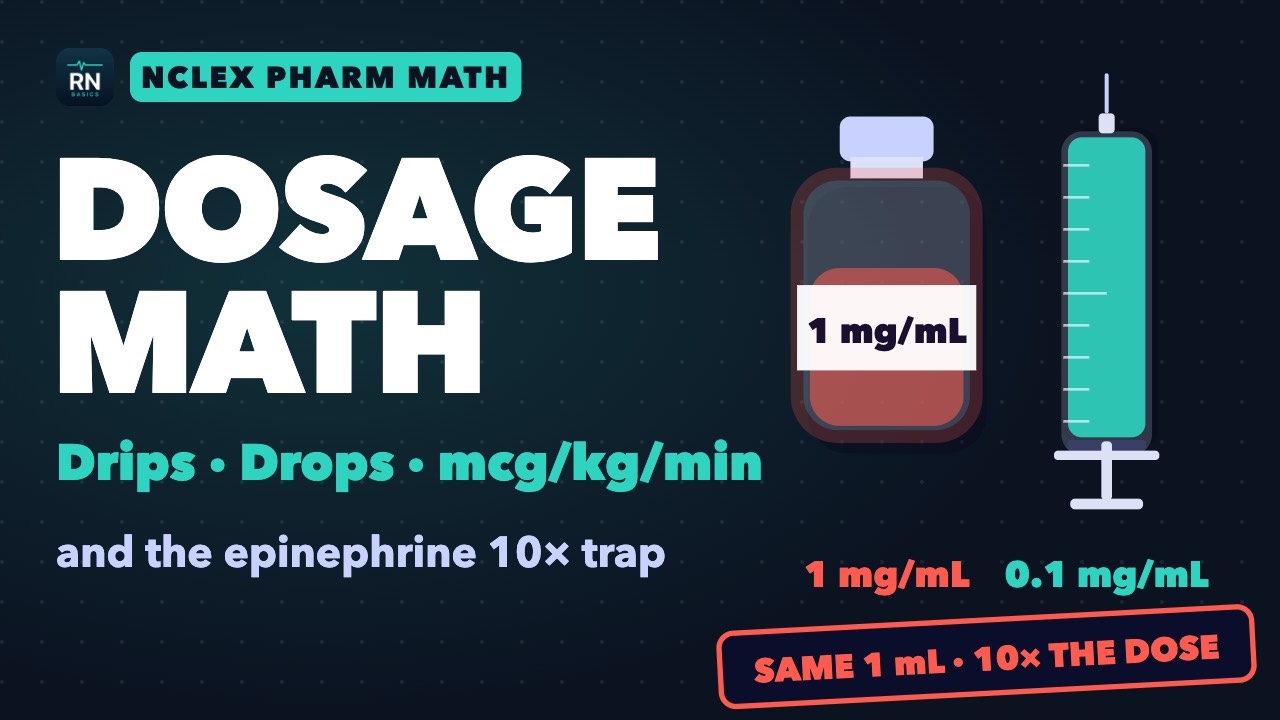
One misplaced decimal is ten times the dose. This video builds dosage math from the metric ladder up.
It covers desired over have and dimensional analysis, weight-based doses, pump and gravity drip rates, units per hour, mcg/kg/min pressor math with a backward check, the epinephrine 1 mg/mL versus 0.1 mg/mL trap with push-dose epinephrine, medic math for dextrose and weight tools, and the rounding and decimal traps on NCLEX, CCRN and NREMT.
Chapters
- 0:00 One decimal, ten times the dose
- 0:21 The metric ladder: g, mg, mcg, kg
- 1:00 Desired over have and dimensional analysis
- 1:53 Weight-based doses: pounds to kilograms
- 2:56 IV rates: pumps and drops per minute
- 4:00 Units per hour: heparin
- 4:40 mcg/kg/min drip math in one line
- 6:09 Epinephrine 1 mg/mL vs 0.1 mg/mL and push-dose
- 8:16 Medic math: dextrose and weight tools
- 8:52 Exam traps: rounding and decimals
- 9:32 Recap
Study the topic
In the Reference
- Desired Over Have
- Weight-Based Dose (mg/kg)
- Drip Rate (drops/min)
- IV Pump Rate (mL/hr)
- Units/hr to mL/hr (Heparin, Insulin)
- mcg/kg/min to mL/hr
Transcript
One decimal, ten times the dose
0:00 One misplaced decimal, and the right drug becomes ten times the dose. Today: the setups for nursing exams, the drip math for the ICU, and the epinephrine math every medic should own. Every number here is an exam example. Your order, your protocol and your pharmacy decide the real ones.
The metric ladder: g, mg, mcg, kg
0:23 Start with the ladder. One gram is a thousand milligrams. One milligram is a thousand micrograms. One liter is a thousand milliliters.
0:34 One kilogram is 2.2 pounds, so to get kilograms, divide pounds by 2.2. Convert first, so the order and the supply are in the same unit. Mix up milligrams and micrograms and the error is a thousandfold. And write the units out: mcg for micrograms, and the word units, never a U, which can be read as a zero.
Desired over have and dimensional analysis
1:03 Method one: desired over have, times the quantity. The order is 375 milligrams. You have 250 milligrams in five milliliters. 375 over 250 is one and a half, times five: 7.5 milliliters.
1:22 Method two: dimensional analysis. Chain fractions so every unit cancels except the one you want. The order is 0.25 milligrams, and the tablets are 125 micrograms. 0.25 milligrams is 250 micrograms. Divided by 125 per tablet: two tablets. Then the sense check. If the answer is ten tablets, or 30 milliliters for one injection, recheck the setup.
Weight-based doses: pounds to kilograms
1:56 A weight-based problem. Fentanyl, one microgram per kilogram. The patient weighs 154 pounds. The vial is 50 micrograms per milliliter.
2:07 154 divided by 2.2 is 70 kilograms. 70 kilograms times one microgram is 70 micrograms. 70 over 50: 1.4 milliliters. Use the pounds as if they were kilograms, and you'd draw up 154 micrograms: 2.2 times the dose.
2:29 The model EMS guideline also caps that first dose at a hundred micrograms, so check the maximum too. One emergency department study found that a weight in pounds entered as kilograms was a common weight error. So weigh and chart in kilograms. For children, multiply the dose per kilogram by the weight, then compare the answer with the safe dose range before you give it.
IV rates: pumps and drops per minute
2:58 Pumps run in milliliters an hour: total volume over total hours. A thousand milliliters over eight hours is 125 an hour. 50 milliliters over 20 minutes: 50 over 20, times 60, is 150 an hour. Without a pump, you count drops: volume times the drop factor, divided by minutes.
3:23 The drop factor is printed on the tubing package. Macrodrip sets are usually ten, 15 or 20 drops per milliliter. Microdrip is 60. A thousand milliliters over eight hours on 15 drop tubing: a thousand times 15, over 480 minutes, is 31.25, so 31 drops a minute.
3:47 Shortcut: on 60 drop tubing, drops per minute equal milliliters per hour. And decimal hours aren't minutes: 12.5 hours is 12 hours and 30 minutes.
Units per hour: heparin
4:03 Heparin is dosed in units. 25,000 units in 250 milliliters is a hundred units per milliliter. For 1,200 units an hour, divide by a hundred: 12 milliliters an hour. But 25,000 units also comes in 500 milliliters.
4:21 That's 50 units per milliliter, and the same order runs at 24 an hour. Program the wrong bag and the dose doubles or halves, which is why the label says to confirm the strength before you give it. If the order is per kilogram per hour, multiply by the weight first.
mcg/kg/min drip math in one line
4:43 The ICU drip formula fits on one line: dose, times weight, times 60, divided by the concentration in micrograms per milliliter. Norepinephrine, four milligrams in 250 milliliters. 4,000 micrograms over 250 is 16 micrograms per milliliter. The order is 0.1 microgram per kilogram per minute, for 80 kilograms. That's eight micrograms a minute, 480 an hour. Divided by 16: 30 milliliters an hour.
5:17 Now check it backward. 30 times 16, over 60, over 80, is 0.1. It matches. The norepinephrine label doses in micrograms per minute, with no weight. Then skip the kilograms: eight times 60, over 16, is still 30.
5:37 The same drug also comes as eight milligrams in 250: 32 micrograms per milliliter. The same dose is 15 an hour. Match the pump to the bag. Dopamine's label prints this same formula.
5:52 Five micrograms per kilogram per minute, 80 kilograms, a 1,600 microgram per milliliter bag: 15 milliliters an hour. The drip calculator in all three apps does this math too. Use it to check your hand math, not to replace it.
Epinephrine 1 mg/mL vs 0.1 mg/mL and push-dose
6:12 Epinephrine comes in two strengths. One milligram per milliliter, the old 1:1,000, and 0.1 milligram per milliliter, the old 1:10,000. US labels now state milligrams per milliliter, because the ratios caused errors. Same drug, same one milliliter: one milligram from the vial, a tenth of a milligram from the syringe.
6:36 Tenfold. Anaphylaxis is intramuscular, from the one milligram per milliliter vial. For an adult, 0.3 to 0.5 milligrams, which is 0.3 to 0.5 milliliters. Cardiac arrest is one milligram IV or IO every three to five minutes, from the 0.1 syringe. That's ten milliliters.
7:01 Watch this. A 20 kilogram child, 0.01 milligram per kilogram: 0.2 milligrams. For anaphylaxis, that's 0.2 milliliters of the vial. For arrest, the same dose is two milliliters of the syringe.
7:17 Same milligrams, ten times the volume. The classic error is the strong vial pushed into a vein. In one published case, an anaphylaxis dose given IV by mistake caused cardiac arrest. push-dose epinephrine, for short-term low blood pressure.
7:35 Take one milliliter of the 0.1 syringe, that's a hundred micrograms, and add nine milliliters of saline. Ten milliliters at ten micrograms per milliliter. An adult dose is ten to 20 micrograms, one to two milliliters, repeated every few minutes per protocol. Mix it from the strong vial by mistake, and the syringe holds a hundred micrograms per milliliter.
8:00 Every push is ten times too big. Label the syringe the moment you mix it, and use a prefilled ten microgram per milliliter syringe where your system stocks one. It's a bridge. It doesn't replace a drip in ongoing shock.
Medic math: dextrose and weight tools
8:18 Medics, percent solutions are grams per hundred milliliters. Dextrose ten percent has ten grams in every hundred. So 25 grams is 250 milliliters of D10, or 50 milliliters of D50. For children, the model guideline says to estimate weight with a length-based tape or another tool.
8:41 Say the drug, the dose, the concentration and the volume out loud, and have your partner confirm. And your local protocol decides the doses and the mixes.
Exam traps: rounding and decimals
8:55 Exam traps. On the NCLEX, round once, at the end. Give exactly the decimal places the question asks for, and type the decimal point. If no rule is given, common teaching is tenths above one milliliter, hundredths below, and whole drops.
9:13 In charting, use a leading zero and never a trailing one: 0.5, not point five; five, not five point zero. And answer in the unit the question asks for: milliliters an hour, drops a minute, milliliters, or tablets.
Recap
9:35 Recap. Convert first, set it up once, and check that the answer makes sense. Divide pounds by 2.2. Pump rate is volume over hours; drops are volume times the drop factor, over minutes.
9:50 For drips: dose, times weight, times 60, over micrograms per milliliter, and check it backward. Match the pump to the bag. Epinephrine: one milligram per milliliter for the muscle, 0.1 for the vein, and push-dose is one plus nine. ICU Basics, RN Basics and Medic Basics, available on the Apple App Store and Google Play.
Sources
- DailyMed, Adrenalin (epinephrine) injection Link
- DailyMed, Norepinephrine in dextrose (premixed) Link
- DailyMed, Dopamine in dextrose Link
- DailyMed, Heparin in dextrose Link
- DailyMed, Fentanyl citrate injection Link
- NCSBN, NCLEX FAQs Link
- Merck Manual Professional, CPR in Adults Link
- Merck Manual Professional, Anaphylaxis Link
- Intravenous epinephrine dosing error, case report (2023) Link
- Ratio versus mass labels for epinephrine, randomized trial (2008) Link
- Pediatric weight errors in the emergency department (2019) Link
- EMS weight documentation and dosing errors (2023) Link
- Push-dose epinephrine survey (2025) Link
- JEMS, A Push for Push Dose Epinephrine Link
- EMS1, Understanding push dose pressors Link
- High-risk abbreviations study (2016) Link
- NASEMSO National Model EMS Clinical Guidelines, version 3.0 (March 2022) Link
For education and exam preparation only. Not medical advice; follow current guidelines and your institution’s protocols. AI narration; script written and clinically reviewed by Alex G.